
In this article
An executive summary gives a busy reader enough context to understand a document’s purpose, main findings and recommended action. It should stand on its own while remaining consistent with the full report or proposal.
Write it after the underlying work is settled. Start with the decision or purpose, include only the evidence that changes it, and state the limits. The example below can be expanded into a short report summary or compressed into one slide.
What to take away.
Lead with the recommendation or decision.
Choose evidence that explains the recommendation.
Keep the most important condition visible.
Download the report summary and one-slide template
Use the report worksheet and complete fictional summary (.txt) beside the editable one-slide template (.pptx). The written summary carries the context; the slide retains the recommendation, decisive evidence, limits and decision. Both describe the same task, not an investor pitch.
For a completed reference, open the fictional summary slide (.pptx) or its PDF preview. The baseline is 18 of 30 accounts over fourteen days; the proposed pilot is six weeks. Keep those periods separate when shortening the report.
The files are free to adapt for personal or commercial presentations. Replace the fictional data and source gaps with your approved analysis. The PPTX contains editable text and shapes; the PDF is a fixed reference. Use Geist and Fraunces or substitute fonts and inspect the layout.
Use five parts for a report or proposal summary
Write the purpose, recommendation, supporting findings, material risks and requested next step. Choose the length for the recipient and document; there is no single correct word count for every executive summary.
| Part | Question to answer |
|---|---|
| Purpose | What problem or decision does this document address? |
| Recommendation | What should happen, or what did the analysis find? |
| Evidence | Which findings justify that conclusion? |
| Limits | What uncertainty, dependency or cost could change it? |
| Action | Who must decide or do what, and by when? |
Make the summary useful without the full document
An introduction establishes the subject and route through the document. An executive summary also gives the result. Do not make the reader open the full report to discover the recommendation.
For a presentation slide, retain the recommendation, the decisive evidence and the requested action. Put supporting detail in the deck or accompanying document rather than shrinking every paragraph onto one slide.
An abstract usually helps a reader decide whether a study or paper is relevant by condensing its question, method, findings and conclusion. An executive summary serves the decision the underlying report supports, including implications and an action request when appropriate. Follow the required publication format: do not add a business recommendation to a research abstract merely to make it sound decisive.
A complete executive summary
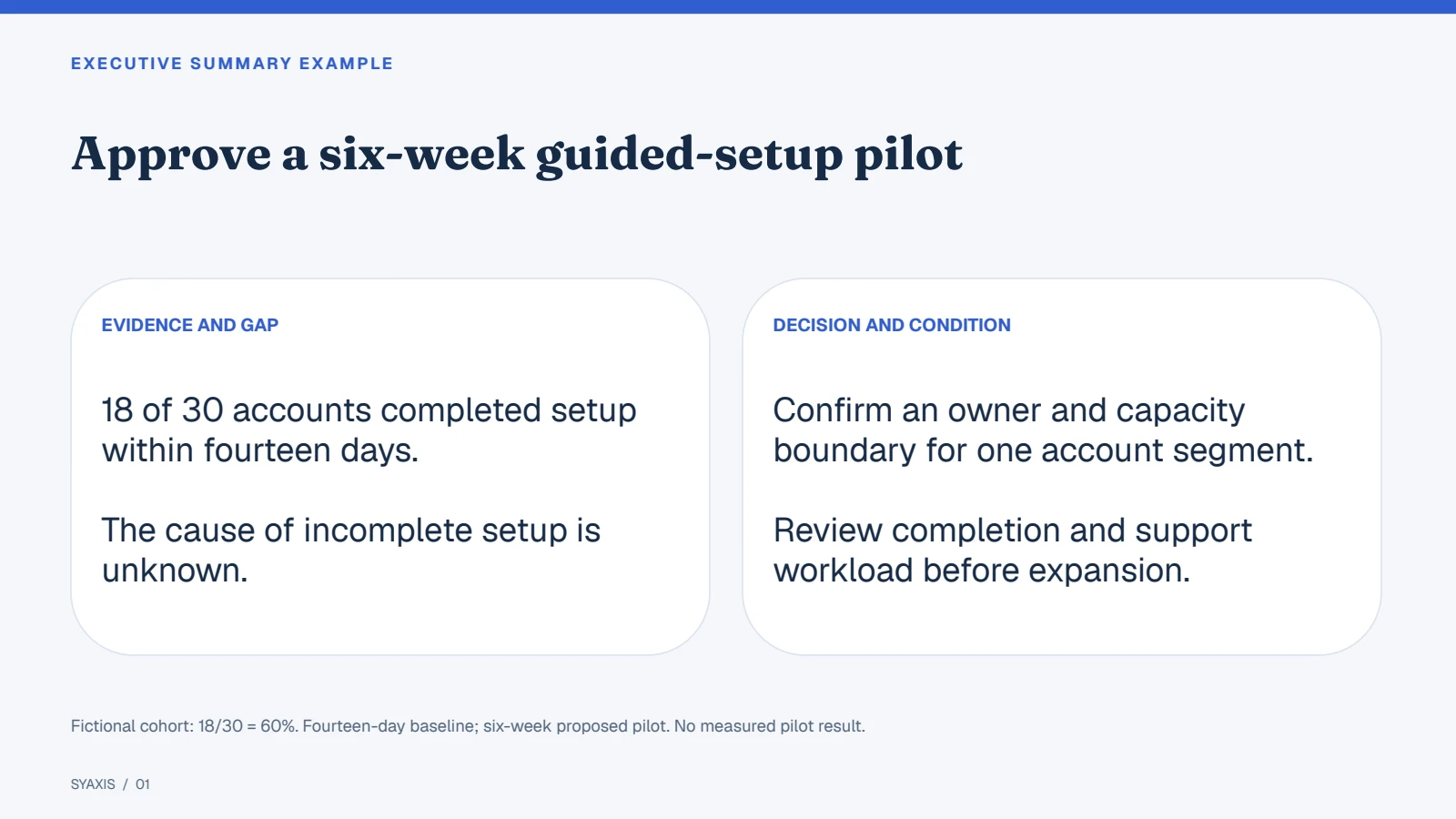
The slide can be read as a short argument. The title states the proposed action; the evidence explains why it deserves consideration; the condition sets the boundary.
A written version can say: “Pilot guided setup before expanding the onboarding program. In the reviewed cohort, 18 of 30 accounts completed setup within fourteen days, a completion rate of 60%. This does not establish why the other accounts did not complete setup. We recommend a six-week pilot for one defined segment, subject to confirmation of an owner and capacity boundary. Review stage-level completion and support workload before any expansion.”
This is a fictional summary of a proposal. Supply the cohort dates, segment definition and available capacity from the underlying report before adapting it. A shorter slide must not make a stronger claim than that report.
| Element | Example copy |
|---|---|
| Headline | Pilot guided setup before expanding the onboarding program |
| Evidence | In the reviewed cohort, 18 of 30 accounts completed setup within fourteen days |
| Interpretation | The sample suggests setup deserves closer investigation; it does not establish the cause |
| Recommendation | Run a six-week pilot for one defined account segment |
| Decision | Approve the pilot owner and capacity boundary |
| Condition | Review stage-level completion and support workload before any wider rollout |
Executive summary slide example: copy the structure
Here is the same fictional proposal reduced to slide-ready copy. Keep the six-week pilot and the fourteen-day baseline measurement separate: they describe different periods. The numbers illustrate the structure; replace them with your own approved evidence.
Title: “Approve a six-week guided-setup pilot for one account segment.” Evidence: “18 of 30 accounts completed setup within fourteen days in the reviewed cohort.” Gap: “We have not established why the other accounts did not complete setup.” Proposal: “Test guided setup before committing to a wider rollout.” Decision: “Confirm an owner and capacity boundary; review completion and support workload before expansion.”
Place the evidence and gap together, with the decision in a clearly separated closing line. This keeps the condition visible when the slide is read without a presenter. It also gives a reviewer specific statements to correct rather than a generic request to improve the summary.
Choose the evidence that changes the decision
Eighteen of thirty accounts is 60%. That calculation may be useful, but the denominator and cohort definition matter as much as the percentage. A slide that only says “60% completion” leaves the reader unable to judge the scope of the evidence.
If the decision is whether to run a pilot, the summary does not need every account detail. It needs enough evidence to explain the concern and the limits of the proposed response. Keep detailed records in the supporting material.
Use hierarchy instead of shrinking the type
Give the recommendation the strongest visual position. Place two or three supporting points beneath it, then make the decision and condition easy to find. If the slide is crowded, remove a secondary point or move detail to the next slide before reducing the text size.
A small process diagram may be useful when the proposal changes a workflow. A decorative photo is less useful if it displaces the evidence. The visual-selection guide explains how to choose a visual that supports the message.
Replace vague summary language
Before: “We reviewed onboarding and identified opportunities to optimize the experience.” This says that work happened but does not help an executive decide anything.
After: “Pilot guided setup for one segment; review completion and support workload before expansion.” This identifies an action and a boundary. It remains a proposal rather than pretending that the intervention’s effect is already proven.
A summary should not introduce a claim absent from the rest of the deck. If the wording becomes more confident as it gets shorter, compare it with the original analysis and restore any necessary qualification.
A status summary would instead lead with what changed since the previous update. A research summary would lead with the finding and method limitation. Keep the single-slide constraint by reducing background, not by collapsing these distinct jobs into one crowded slide.
A precise AI request
“Create one executive summary slide from this approved analysis. Include the proposed action, two supporting observations, the decision needed and the condition for proceeding. Preserve the cohort definition and uncertainty. Do not add a savings estimate or claim that the pilot will succeed.”
After drafting in Syaxis, ask the model to shorten the wording while preserving those four roles. Review the result against the source rather than judging it only by how polished the title sounds.
Where the summary belongs
Put it near the beginning when the audience needs the answer before the detail. Revisit the decision at the end if the meeting requires approval. A summary at the start and a closing decision slide can serve different purposes without repeating the entire same paragraph.
For a governance discussion, see the board presentation outline. For client analysis, see the consulting deck. Both require the headline to remain consistent with the underlying evidence.
FAQ
Should an executive summary be one slide?
Often one slide is a useful constraint, but it is not mandatory. If several independent decisions require different evidence, separate them rather than hiding the distinction in tiny text.
Can I put the agenda on the summary slide?
An agenda explains the order of the meeting. A summary explains the conclusion and decision. Keep those jobs separate when combining them would weaken either.
Can the executive summary be written before the full deck?
Draft the decision and evidence requirements first. Finalize the summary after checking the detailed slides so its numbers, conditions and requested action agree with the supporting material.
Bring it into your work.
Draft the summary after checking your presentation templates and meeting outlines, then use it to test whether the deck has a coherent argument.
How we prepare our guides
Syaxis uses AI to assist with drafting and translation. Comparisons draw on linked sources; they are not hands-on tests unless a test method is described. Worked examples are illustrative unless identified otherwise.


