
In this article
To write a case study, define one case and its question, gather the evidence, explain the actions or alternatives, and state what the findings do and do not support. This guide includes a copyable template, a complete short business example and a six-slide presentation structure.
Use it for a business or consulting analysis, and adapt the method and citations to your assignment if you are writing an academic case study. A customer success story also needs verified outcomes and approval to publish.
What to take away.
Choose the case and its boundary before collecting material.
Keep observations, interpretations and proposals separate.
A useful case study can explain an unresolved question without inventing a success story.
1. Choose the kind of case study you need
A case study examines a particular situation in enough detail to explain what happened, what evidence supports the account and what someone can learn from it. Start with a bounded case: one project, organization, decision or implementation during a stated period. “How a support team changed its handoff” is a case; “everything about customer service” is not.
The reader determines the format. A customer success story needs verified outcomes and permission to publish. A consulting case analysis evaluates alternatives and recommends a decision. An academic case study explains its research question, method and evidence. Follow your assignment or publication requirements before using a business template.
A case study and a use case answer different questions. This guide’s approval-process case examines twenty completed requests, a six-working-day median and missing stage timestamps. A use case instead describes a task such as “a reviewer receives a request, asks for missing information and records a decision.” It can specify intended behavior without proving that behavior improved results. Use the case study for a bounded evidence-led account; use the task description to explain how a proposed process would work.
| Format | What the reader needs |
|---|---|
| Customer story | Problem → intervention → outcome → customer perspective. Verify quotations and obtain approval before publication. |
| Business or consulting analysis | Situation → evidence → alternatives → recommendation. Distinguish a proposed improvement from a measured result. |
| Academic case study | Question → case selection → method → findings → limitations. Explain how evidence was collected and cite sources using the required style. |
2. Gather evidence before drafting the story
Write one question the case should answer. For an approval-process case: “Where do requests wait, and what change is justified by the available evidence?” Specify the team, dates, types of requests and exclusions. The boundary makes it possible to distinguish an observation about this case from a general claim.
Collect original records, interviews and relevant documents. Keep the source location beside each note so you can check a quotation or calculation later. Interview questions should elicit events and decisions: What happened before the change? What options were considered? What changed in practice? What did not improve?
Ask for the denominator behind a percentage, the period behind a total and the baseline behind an improvement claim. If a source only records submission and completion, it cannot establish which intermediate step caused the delay. Record that gap instead of filling it with a plausible explanation.
| Evidence note | What belongs in the source record |
|---|---|
| Observation | Twenty completed requests; median submission-to-approval time of six working days. Keep the record dates and definition of a working day. |
| Interpretation | Handoffs may contribute to delay. This needs stage-level timestamps, not just the overall completion time. |
| Proposal | Pilot routing rules for one team. This is an action to test, not an achieved reduction in approval time. |
3. Use a case study template that keeps claims traceable
Copy the structure below into your writing tool or download the plain-text case study template. It contains prompts and a source ledger, not prewritten customer results. Use only the parts relevant to your case.
Write the detailed findings before the opening summary. That makes the summary an accurate account of what the evidence supports. A result can be a useful limitation: discovering that the available records cannot identify a cause is preferable to presenting a guessed cause as a finding.
| Part | What to write |
|---|---|
| Title and summary | Name the case and its main finding or decision. Include the organization or project boundary and period. |
| Context and question | Who faced the problem? What decision or research question made the case worth examining? |
| Method and evidence | Which records, interviews or observations were used? How were they selected, and what is missing? |
| Actions or alternatives | Describe what actually happened. For an unfinished decision, compare available options rather than inventing an intervention. |
| Findings and limitations | Give the result with its baseline, dates and definition. Explain what the evidence cannot establish. |
| Implication and next step | State what the reader can reasonably do with the finding and what further evidence would change the recommendation. |
Download the writing worksheet and matching six-slide case
Complete the case-study worksheet (.csv) with the question, case boundary, method, findings, alternatives, recommendation and source locations. The plain-text writing template remains available if you prefer a document.
Read the complete fictional business case (.txt) beside its completed claim ledger (.csv). The ledger shows which statements the example supports and which facts are missing. It is a worked editorial example, not an actual customer record.
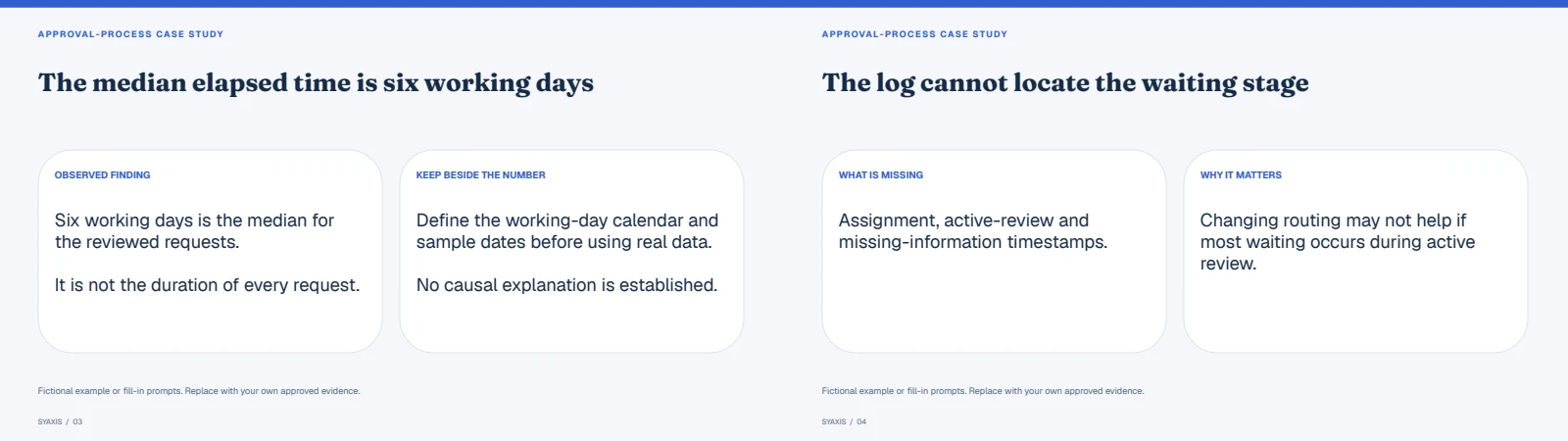
The editable six-slide case study (.pptx) and PDF preview carry the same argument into a meeting. Twenty requests and a six-working-day median describe the sample; they do not identify the cause of waiting or prove that a routing pilot worked.
You may adapt these original files for personal or commercial use. Replace fictional data, identify your source permissions and check citations before sharing. For a short decision summary of the completed analysis, use the executive summary guide; the case itself still needs its method and evidence.
4. Read a worked case study example
The following is a fictional business analysis, provided to show the relationship between evidence and wording. It reports no customer outcome or Syaxis performance claim.
Title: Approval records show a six-day median, but do not locate the delay. A team reviewed twenty completed requests to decide whether to replace its approval system. The available log contained submission and completion dates but no timestamps for intermediate handoffs.
Finding: The median elapsed time was six working days. This describes the reviewed requests; it does not show that every request took six days. Because the log did not record individual stages, the team could not determine whether requests waited for assignment, active review or missing information.
Options: Keeping the process avoids transition work but leaves the cause unresolved. A routing pilot could test whether assignment contributes to waiting, provided stage-level timing is added. Replacing the system would require a broader requirements and implementation assessment before a cost or benefit claim could be justified.
Recommendation: Collect stage-level timestamps and run a bounded routing pilot if assignment delays are confirmed. Name an owner and compare like-for-like requests before and during the pilot. Do not claim reduced approval time until the completed pilot supplies that evidence.
5. Draft, cite and revise without changing the evidence
Use an opening sentence that answers the section’s question, then give the supporting detail. “The log cannot locate the delay” tells the reader more than “Process analysis.” Keep the qualification next to the finding so it survives copying into a summary or slide.
AI can help organize notes and rewrite a passage. In Syaxis Chat, try: “Draft a case study from this source packet. Separate observations, interpretations and proposals. Keep each factual claim linked to the source label supplied in my notes. Identify missing evidence instead of adding results or quotations.” Check the draft against the originals before sharing.
Compare these two sentences: “The new process cut delays by 40%” and “The team proposed a routing pilot; its effect has not yet been measured.” Only the second fits this example. Stronger language cannot repair missing data. A second AI answer is not independent evidence if it uses the same notes.
For a research assignment, use the required citation style and report the actual method. For a customer story, verify names, quotations, metrics and publication permission with the people responsible. Do not repurpose a private interview as an approved testimonial.
6. Adapt the case study into a consulting presentation
A written case study lets readers inspect the account at their own pace. A presentation needs a shorter sequence built around the meeting’s decision. Preserve the source references and limits when shortening: a proposed pilot must still be a proposal on the slide.
Once the source packet and argument are ready, ask the Syaxis presentation agent: “Create six slides from this approval-process case. State a supported point in each title. Separate the observed six-day median from the hypothesis about handoffs. Compare the three options and end with the evidence needed before expansion.” You can discuss the case in Chat first; request the presentation when you have chosen the material to use.
| Slide | Content from the case |
|---|---|
| 1. Decision | Collect timing evidence before choosing a system change. |
| 2. Case boundary | One team and twenty completed requests; identify the sample period. |
| 3. Finding | Six-day median, with the source and definition visible. |
| 4. Missing evidence | Submission and completion dates cannot locate the waiting stage. |
| 5. Options | Keep the process, test routing or assess a replacement. |
| 6. Next step | Agree the pilot owner, measurement and condition for expansion. |
7. Check what the finished case study actually establishes
Read every claim of improvement against its source. Compare periods using the same measure and population. Separate a change observed after an intervention from proof that the intervention caused it. Remove unsupported quotations, numerical precision and claims that the experience applies to every organization.
For a consulting recommendation, ask what would change your decision. In this case, if most waiting happens during active review rather than assignment, routing alone may not address it. State that condition beside the recommendation.
For slides, check the exported file for legible source labels and figures. Add your own speaker notes if you need delivery reminders. For a short management readout, use the executive summary guide; for a study with a formal method, use the research presentation guide.
FAQ
How long should a case study be?
Use the length required by the assignment, publication or reader. A short customer story and a formal research case need different detail. Include enough information to check the case boundary, evidence and conclusion; put supporting records in an appendix rather than cutting a qualification that changes the meaning.
What if the project has no measured outcome yet?
Write an analysis or decision case. State the available evidence, compare options and describe the proposed next step. Label the intervention as proposed and explain how its effect will be assessed. Do not present expected savings or a planned result as an achieved outcome.
Can AI write the case study from interview notes?
AI can organize supplied notes, draft text and help identify unanswered questions. You remain responsible for checking sources, quotes, permission and conclusions. Ask it to flag missing evidence and keep source labels attached to claims; a generated quote or citation is not a substitute for an original record.
Bring it into your work.
Start with the case study template, then choose a presentation structure if you need to discuss the findings in a meeting.
How we prepare our guides
Syaxis uses AI to assist with drafting and translation. Comparisons draw on linked sources; they are not hands-on tests unless a test method is described. Worked examples are illustrative unless identified otherwise.


