Verifying an AI presentation means checking the relationship between a claim and its evidence. A working link, a familiar publisher or a second assistant’s agreement is not enough.
Start with the claims that could change the audience’s decision: important numbers, product capabilities, causal explanations and recommendations. Then check the final file for qualifications lost during drafting or export.
Open the original source and locate the supporting passage.
Check the period, denominator and strength of the wording.
Keep unresolved claims out of a confident headline.
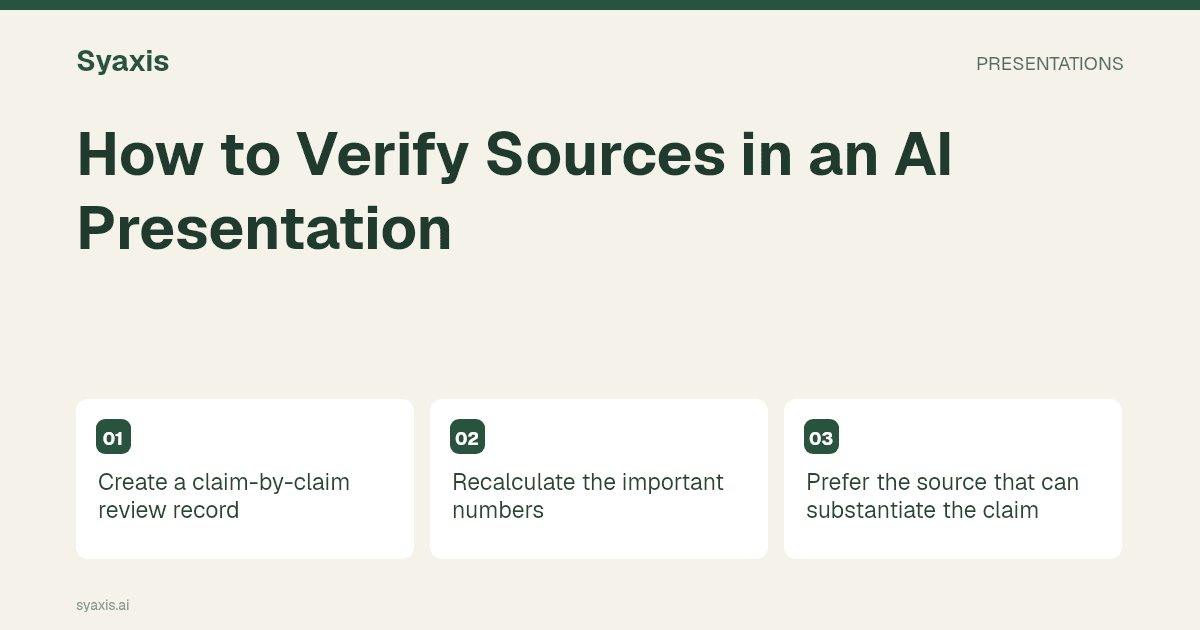
Create a claim-by-claim review record
You do not need a complicated system for a short deck. A small table beside the presentation can record what was checked and what remains open.
| Slide claim | Check | Decision |
|---|---|---|
| “Completion rose to 60%” | Find the numerator, denominator and period | Keep only with those definitions |
| “The change caused the improvement” | Look for evidence of causation, not just timing | Weaken or remove if unsupported |
| “The tool exports editable PPTX” | Check current official product documentation and plan | State the relevant qualification |
| “Customers prefer this option” | Inspect who was asked and how | Use the sample-specific finding if that is all the evidence supports |
Recalculate the important numbers
If a slide says a measure rose from 40 to 50, the absolute increase is 10 and the relative increase is 25% from the original value. A change from 40% to 50% is 10 percentage points, although it is also a 25% relative increase. These descriptions are not interchangeable.
Check the direction of the denominator and the reporting period. A chart that mixes monthly and quarterly figures can look coherent while supporting no valid comparison. If the source data is missing, do not repair the story by guessing.
Prefer the source that can substantiate the claim
For a product capability, start with the vendor’s current documentation rather than an undated review. For a study result, locate the study or original report. A news summary may be useful context, but it can omit the method or caveat needed for your slide.
Check whether several articles are repeating the same underlying source. Ten links do not constitute ten independent pieces of evidence when they all lead back to one press release or study.
Look for claims strengthened by summarization
Common changes include “may” becoming “will,” an association becoming a cause, a sample becoming a population and a proposed benefit becoming a measured result. Compare the headline with the source wording and restore the necessary boundary.
The correction need not make the slide unreadable. “Four interview participants described unclear setup steps” can be concise and accurate where “most customers struggle with setup” is not justified. The research presentation example shows this distinction.
Check what visuals imply
A generated image of a new facility can be an honest concept illustration if labeled appropriately. It should not appear to document a completed site. A generated chart-like picture should not substitute for a chart built from verified numbers.
Inspect captions, axis labels and crop choices. A truthful dataset can still be presented misleadingly if the visual removes a relevant baseline or hides an exception. Use presentation visuals to choose the right form for the evidence.
Make the correction in the presentation
In Syaxis, request a specific change: “Replace the population-wide claim on slide three with the sample-specific finding, and preserve the source period.” Review the revised slide and any summary that repeats the claim.
After exporting PowerPoint, confirm that the caveat and source context survived. Keep the reviewed source ledger with the final deck so a later editor can see why the wording was chosen. The research-to-presentation workflow explains where this record belongs.
Perguntas frequentes
Is a source link enough to verify a slide?
No. The linked source must support the exact claim and its scope. Locate the relevant passage or table and check the interpretation.
Can another AI verify the deck for me?
It can help identify issues or locate evidence, but agreement between models is not proof. An accountable reader still needs to inspect important claims against their sources.
Use the PDF-to-presentation guide when the main challenge is preserving source meaning while compressing a longer report.
Um briefing mais claro. Uma apresentação mais forte.
Traga suas ideias para a Syaxis e dê a elas uma história, uma estrutura e slides que valem compartilhar.