AI can help you study when the activity makes your understanding visible. An answer you cannot explain is a weak learning outcome, even if it looks complete.
Start with a specific task and source material.
Check the claims and the final deliverable.
Choose tools by the workflow and limits you actually need.
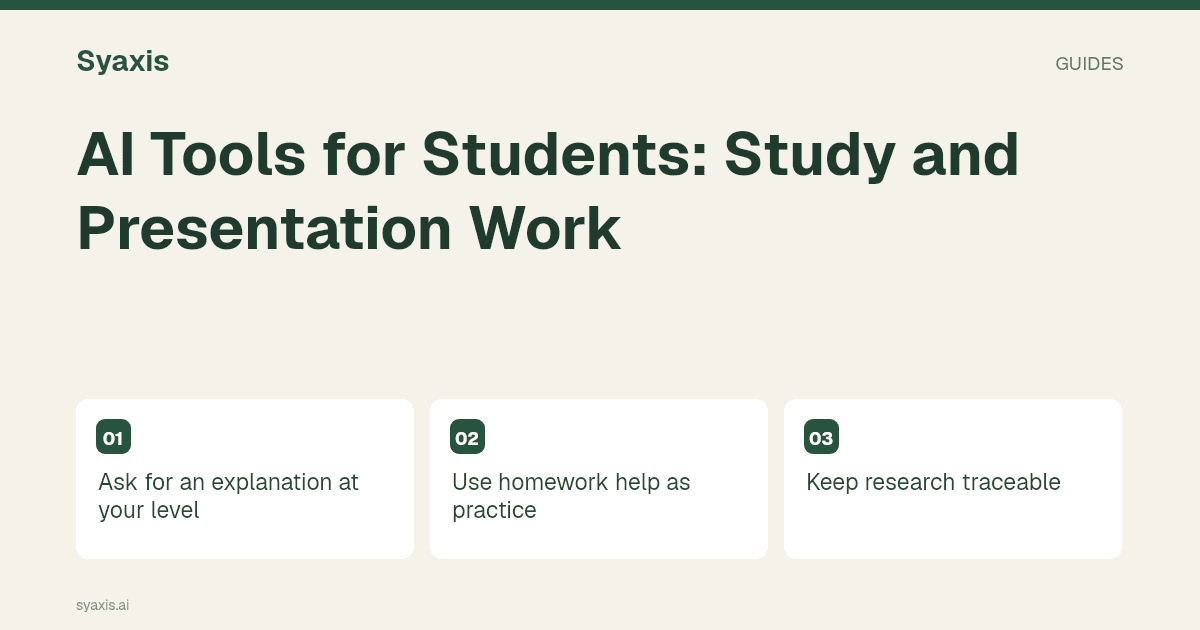
Ask for an explanation at your level
Provide the concept, your current understanding and where you are stuck. Request an explanation and a short example, then restate the idea in your own words.
A useful follow-up is “Ask me one question that checks whether I understood, and wait for my answer.” Do not treat fluent wording as proof that the explanation is correct.
Use homework help as practice
Try the problem first. Ask for a hint about the next step rather than a finished submission, then explain your reasoning and request feedback.
Follow the course’s rules on AI assistance. Do not submit generated work as your own when that is prohibited, and verify calculations and citations.
Keep research traceable
Use AI to identify search terms and organize reading notes. Open the original sources, confirm quotations and keep bibliographic details.
For papers or projects, use the academic research workflow rather than relying on invented references.
Build a presentation you can explain
Create an outline around the learning objective, one worked example and a clear conclusion. Review the slide content against your course materials.
Syaxis can help create a presentation from notes, with Chat and images available within plan limits. Follow the service’s age requirements, your institution’s rules and any provider-specific access restrictions.
Choose assistance that keeps the learning visible
For a class presentation, the useful sequence is understand the material, build an argument and rehearse explaining it. A chatbot can help generate questions or alternative explanations; a presentation workflow can help organize an approved outline. Neither step replaces reading the source or knowing why the claim is justified.
Use a fictional assignment comparing two explanations of an experiment. Ask the assistant to identify the claim and evidence in your notes, then propose three questions a classmate might ask. Draft the answer yourself before requesting feedback. Follow your institution’s AI rules and the product’s age and account requirements; a tool being available on the web does not mean it is permitted for every student or assignment.
| Study task | Helpful AI role | What the student must retain |
|---|---|---|
| Read a difficult source | Explain unfamiliar terms | Verify meaning against the text |
| Prepare slides | Organize an approved argument | Ownership of claims and citations |
| Rehearse | Ask questions about the presentation | Ability to explain without generated answers |
Perguntas frequentes
Can I submit an AI-generated presentation unchanged?
Check your institution’s rules and assignment requirements. You remain responsible for the content, evidence and any required disclosure of AI assistance.
For teaching material, use the lesson presentation example. For evidence-heavy assignments, follow the academic research workflow before building a presentation outline.
Um briefing mais claro. Uma apresentação mais forte.
Traga suas ideias para a Syaxis e dê a elas uma história, uma estrutura e slides que valem compartilhar.