Using ChatGPT and Claude together can give you a useful second review, provided the handoff is explicit. The aim is to improve a deliverable, not to collect two confident answers and assume agreement makes them true.
Define the recurring task before choosing a tool.
Distinguish model access, native features and plan limits.
Review the result against the original sources and goal.
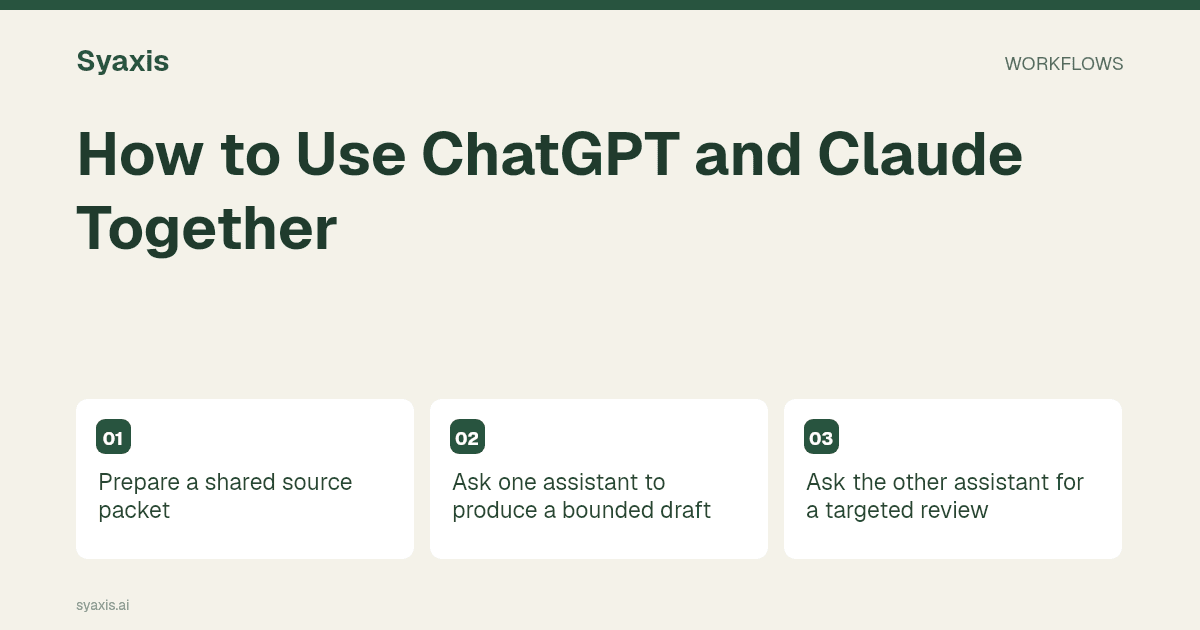
Prepare a shared source packet
Create a short brief with the audience, purpose, approved facts and constraints. Include the current draft and a list of open questions when moving between tools.
Use only information you are authorized to share with each service. Do not assume account settings or uploaded files transfer from one product to another.
ChatGPT Work’s overview and Claude’s file guide establish their document-oriented capabilities. Assigning one a drafting role and the other a review role is the editorial method proposed here, not a vendor claim that the combination guarantees better accuracy.
Ask one assistant to produce a bounded draft
For example: “Draft a six-slide client proposal from these notes. Use action titles, preserve uncertainty and leave missing commercial terms unresolved.” Keep the source packet with the result.
Choose either assistant for this first step. A useful workflow does not require claiming that one always writes and the other always reasons better.
Ask the other assistant for a targeted review
Request unsupported claims, gaps in the story and likely audience questions. Ask it to point to the specific sentence or slide that needs attention rather than rewriting everything.
Accept a criticism only after checking it. A second model can also misunderstand the evidence or propose an unnecessary change.
Apply verified changes and finish the work
Keep one current version of the draft and a short decision log. Otherwise the two conversations can diverge and you may accidentally deliver an older version.
Syaxis lets eligible paid users choose available OpenAI and Anthropic models within its own Chat workflow. That is not the same as bundling ChatGPT and Claude subscriptions or their native integrations. Compare plans.
Assign different responsibilities to the two passes
A practical division is writer and skeptical reviewer. Give the writer approved facts and the requested format; give the reviewer the same facts, the draft and a narrow task such as finding unsupported promises. Avoid asking the reviewer simply whether the first answer is good: that invites a stylistic opinion instead of a useful check.
Try a fictional proposal for a four-week pilot. The writer must state the scope, owner and decision needed. The reviewer flags any invented saving, implied guarantee or missing responsibility. Send only accepted corrections back for revision, then compare the final proposal with the source packet yourself. This division can also be reversed; the point is distinct responsibilities, not a permanent claim that one provider is the better writer.
| Pass | Instruction | Required result |
|---|---|---|
| Draft | Write the proposal from approved facts | A clear recommendation with no invented result |
| Review | Find claims the packet does not support | A claim-by-claim explanation |
| Revise | Apply these accepted corrections only | A final draft preserving scope and dates |
자주 묻는 질문
Should I send the entire conversation to the second assistant?
Usually send a compact brief, the approved sources and the draft to review. A long transcript can mix rejected suggestions with facts and make the second pass less focused.
The Claude vs ChatGPT guide helps choose a primary workspace. Use the comparison scorecard to evaluate the result and the model handoff method to keep corrections clear.
더 명확한 요청. 더 설득력 있는 프레젠테이션.
생각을 Syaxis에 가져와 이야기와 구조를 잡고 공유할 만한 슬라이드로 만드세요.