An AI writing tool should help you express something you can stand behind. For professional work, fidelity to the source and control over revision matter as much as the fluency of the first draft.
Start with a specific task and source material.
Check the claims and the final deliverable.
Choose tools by the workflow and limits you actually need.
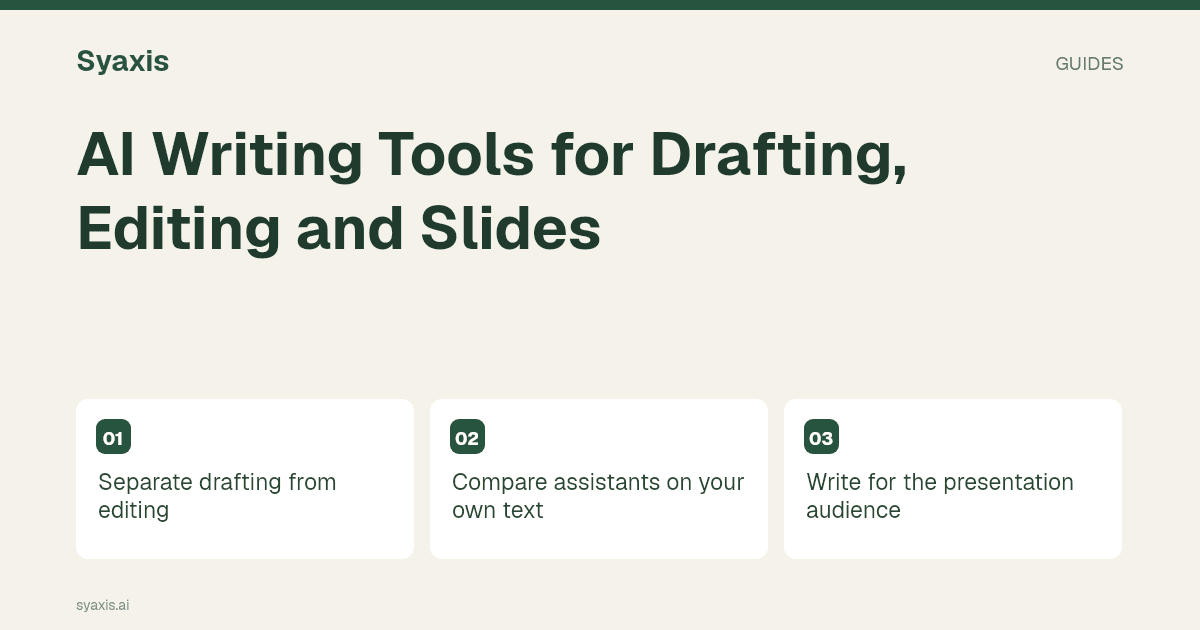
Separate drafting from editing
For a new draft, provide the purpose, audience, evidence and desired structure. For editing, supply the current text and say what must stay unchanged.
A request to “make this better” can change meaning as well as style. Specify whether the task is shortening, clarifying, reorganizing or changing tone.
Compare assistants on your own text
ChatGPT Work documents creating and refining documents, Claude documents file creation and editing, and Gemini Canvas supports document work. These capabilities make them candidates for a writing trial; they do not establish which produces better prose. Use the same source packet and revision.
Do not choose from an unsupported claim that one model always writes best. Review factual changes and the effort needed to reach publishable copy.
Write for the presentation audience
A spoken explanation can be shorter and more direct than a report. Ask for a clear opening, transitions and the question each slide answers, then read it aloud.
Keep important qualifications on the slide or in the spoken explanation rather than hiding them in supporting material.
Preserve the author’s responsibility
Verify quotations, claims and names. Remove generic filler that does not advance the reader’s understanding. Use a second model for critique if useful, but check its suggestions yourself.
Syaxis Chat can help develop the writing before you build a presentation. See using multiple models for a practical draft-and-review workflow.
Pick the editing problem before picking the assistant
A blank-page draft, a structural edit and a factual review are different writing jobs. ChatGPT, Claude and Gemini are candidates for general drafting workflows; the useful choice depends on available files and editing surfaces. A presentation workflow adds another requirement: the prose must support a spoken argument rather than read like a compressed article.
Take this fictional source: a pilot covers two teams for four weeks and has no measured results yet. A sound rewrite can make the invitation clearer but cannot claim proven savings. Ask for an email, an executive summary and three slide titles from the same facts. Compare whether the writing changes for the audience while the commitments remain fixed. Keep the version that needs fewer factual repairs, not the most enthusiastic one.
| Writing job | Useful request | Review criterion |
|---|---|---|
| First draft | Organize these approved facts for this reader | Complete, relevant structure |
| Structural edit | Move the decision and supporting evidence earlier | A clearer argument without new facts |
| Line edit | Shorten while preserving dates and caveats | Meaning survives compression |
| Slide copy | Write assertion-style titles and brief support | Speakable language and readable density |
자주 묻는 질문
Can AI writing tools supply missing evidence?
They can help identify what is missing or retrieve sources when supported, but a fluent sentence is not evidence. Do not publish invented results, citations or customer statements.
Use Claude vs ChatGPT to narrow a document-writing shortlist. For a concise deliverable, try the executive summary slide; for clearer inputs, follow the prompt-writing method.
더 명확한 요청. 더 설득력 있는 프레젠테이션.
생각을 Syaxis에 가져와 이야기와 구조를 잡고 공유할 만한 슬라이드로 만드세요.