A marketing tool earns its place when it helps complete a specific part of a campaign. Buying a separate AI product for every content format can create more handoff work than it removes.
Start with a specific task and source material.
Check the claims and the final deliverable.
Choose tools by the workflow and limits you actually need.
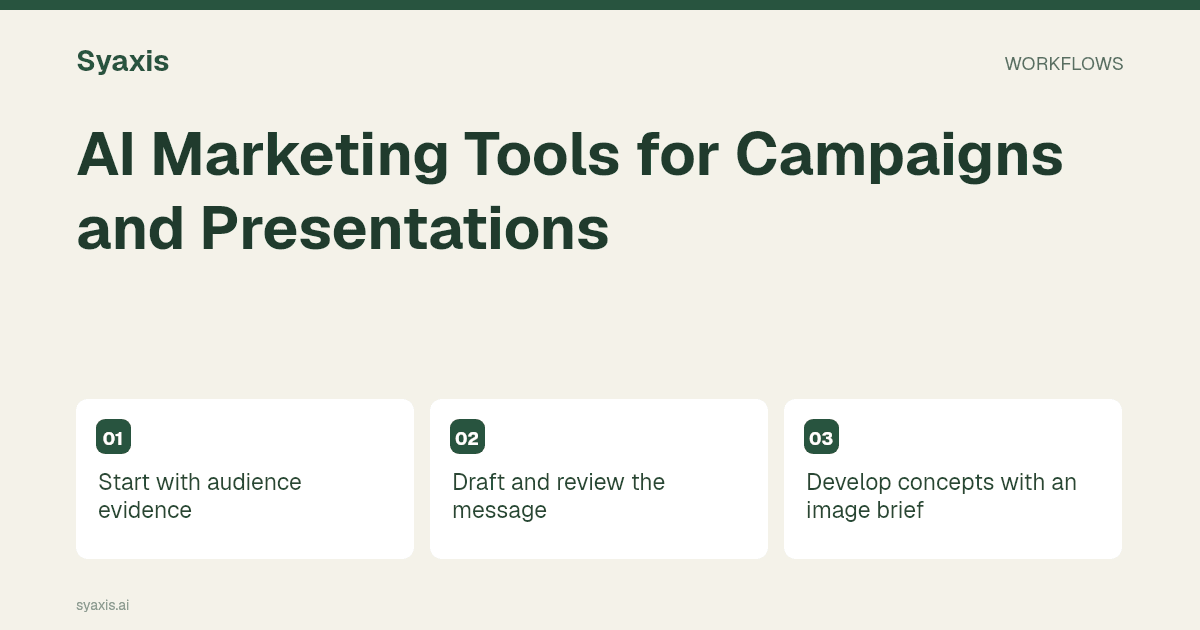
Start with audience evidence
Collect permitted customer notes, product facts and the decision the campaign should support. Use research tools to explore questions, then verify important claims against original sources.
Do not turn generated customer quotes into testimonials or treat an illustrative persona as a measured segment.
Draft and review the message
Use a general assistant or multi-model Chat to propose message directions. Ask for each direction’s audience, evidence and likely objection.
Test copy against the actual offer. Remove unsupported guarantees, invented results and promises that the product cannot deliver.
Develop concepts with an image brief
Use image creation for concepts, settings or supporting illustrations. Keep the brand assets and factual product details under review.
See visual prompts for presentations for examples that leave room for editable headlines.
Make the plan reviewable
Bring the audience, message, channels, resources and measurement into a marketing strategy presentation. Show trade-offs rather than listing every possible activity.
Syaxis combines these preparation tasks with Chat, images and presentation creation. Choose the subscription based on actual usage limits and outputs, not an assumed replacement for every marketing platform.
Connect each tool to a campaign deliverable
A campaign can involve research, messaging, visuals and a decision deck. Buying a separate AI tool for each step is not automatically efficient. Start with the artifact the team reviews and work backward: what source material, image treatment and approval process are needed to produce it?
For a fictional course launch, keep one approved audience, offer and set of claims across the landing-page draft, email and pitch deck. Use chat for message alternatives, an image workflow for conceptual visuals and a presentation tool for the internal decision. Review every version for the same constraints. A tool that invents testimonials or changes the offer creates a new review burden even if its output looks polished.
| Campaign need | Workflow to evaluate | Approval check |
|---|---|---|
| Messaging | A general assistant with source material | Offer and claims match the approved brief |
| Visual exploration | Chat image creation or a design editor | Concept art is not presented as real evidence |
| Stakeholder approval | A source-led presentation workflow | Budget assumptions and decision are explicit |
자주 묻는 질문
Should a marketing team automate publishing as well as drafting?
Treat publication as a separate decision with its own approvals. Drafting assistance does not establish that claims, rights, offer details or channel requirements have been reviewed.
Begin with the marketing prompt examples, then build a strategy presentation. Evaluate the image workflow separately so attractive visuals do not hide weak campaign claims.
더 명확한 요청. 더 설득력 있는 프레젠테이션.
생각을 Syaxis에 가져와 이야기와 구조를 잡고 공유할 만한 슬라이드로 만드세요.