A side-by-side comparison should reveal which model helps with your task. It needs consistent inputs and criteria, otherwise you may be comparing different prompts, context or product features rather than the models.
Define the recurring task before choosing a tool.
Distinguish model access, native features and plan limits.
Review the result against the original sources and goal.
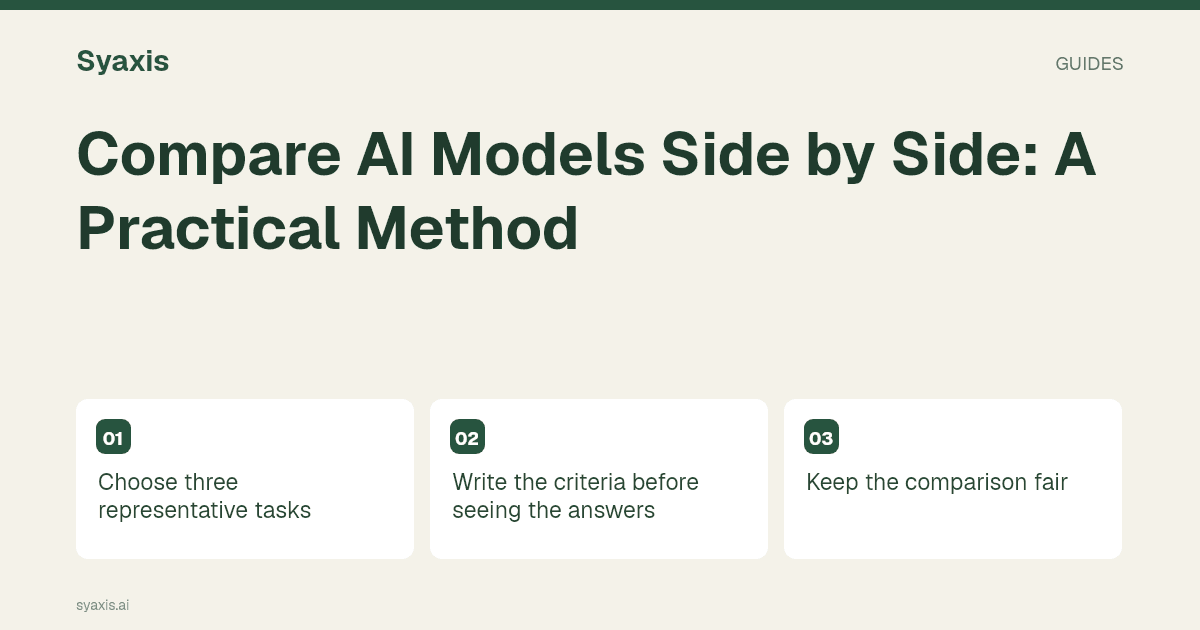
Choose three representative tasks
Use a source-based summary, a draft for a real audience and a correction to an existing result. These reveal different weaknesses: missed facts, poor structure and failures to follow a bounded change.
Avoid using confidential material unless each tool is approved for it. A fictional brief with a known answer is often enough to expose the workflow.
Write the criteria before seeing the answers
Score factual fidelity, completeness, format compliance and the effort needed to make the output usable. Define what a serious error looks like, such as a fabricated number or a recommendation that contradicts the source.
Use notes alongside scores. Two answers with the same score can fail in very different ways.
Keep the comparison fair
Start a clean conversation with each candidate. Provide the same instructions and sources, then allow the same number of revision attempts. Record the model and product surface shown at the time.
If one product has search or file tools and another does not, call it a product-workflow comparison rather than a pure model comparison.
Choose for the recurring job
Prefer the result that meets your requirements with manageable review effort. Recheck when the task or available models change; a small trial does not establish a permanent leaderboard.
You can perform this comparison manually in separate conversations. Syaxis does not need to provide a simultaneous split-screen generation feature for the method to work.
Score errors that matter to the decision
Before generating answers, write down disqualifying errors. For a client update these might be an invented commitment or the wrong delivery date; for research, a citation that does not support the claim; for slides, a chart whose label contradicts the underlying data. This prevents impressive phrasing from hiding an unusable result.
Use three permitted tasks from your normal work and keep prompts, source material and allowed revisions consistent. Read outputs without the model names if practical. Record corrections and completion time, then repeat any surprising result. The scorecard below is a method you can use; it contains no fabricated benchmark results and does not imply that Syaxis has run the comparison for you.
| Criterion | Record | Interpretation |
|---|---|---|
| Source fidelity | Unsupported or altered facts | A serious error can outweigh polished prose |
| Task completion | Missing required parts | An incomplete answer needs additional work |
| Revision quality | New errors after one correction | Improvement should preserve valid content |
| Handoff effort | Minutes of necessary manual work | Evaluate the usable final result |
よくある質問
How many prompts make a fair benchmark?
A few prompts can guide your personal choice but cannot support a broad performance claim. Use varied recurring tasks and repeat observations before generalizing beyond your own workflow.
Apply the scorecard to ChatGPT, Claude and Gemini, ChatGPT and Grok, or the DeepSeek purchasing comparison. Measure the complete workplace task, including review and handoff.
明確な要件から、伝わるプレゼンテーションへ。
考えをSyaxisに持ち込み、ストーリーと構成を整え、共有したくなるスライドにしましょう。