ChatGPT Plus is worth considering when the paid product solves a recurring limitation in your current workflow. The right question is what you can complete with it that you cannot complete comfortably with your existing tools.
Define the recurring task before choosing a tool.
Distinguish model access, native features and plan limits.
Review the result against the original sources and goal.
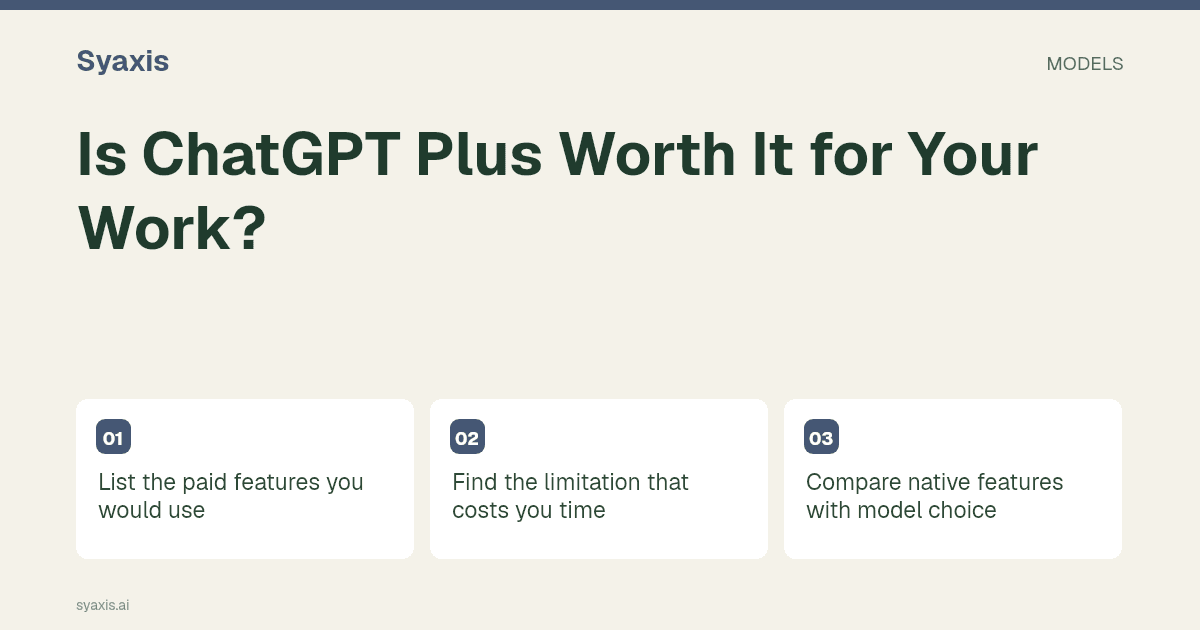
List the paid features you would use
Write down your recurring jobs: working with files, developing presentations, researching a question or creating visual material. Confirm each feature in the current plan and account rather than assuming every ChatGPT capability has the same access.
OpenAI’s presentation guide is one starting point for evaluating deck work.
Find the limitation that costs you time
Record where your current workflow stops: usage caps, unavailable tools, difficult handoff or time spent copying context. A paid plan only helps if it addresses the limitation you actually encounter.
Do not equate paid access with unlimited use. Check the current billing page and feature allowances before subscribing.
Compare native features with model choice
If your priority is the native ChatGPT app and its integrations, an API-based multi-model product may not replace it. If you want several models alongside presentations and images, compare that broader task with a product such as Syaxis.
Syaxis provides its own tools and limits; it does not bundle ChatGPT Plus. See multi-model subscription differences.
Make the decision from a working example
Try a representative task, a revision and the final output. Count review and correction time as well as generation time. A short trial is more informative than a generic claim that a paid model is always better.
Reassess when your work changes. A subscription that is useful during a large project may be unnecessary during a quieter period.
Calculate value from completed work, not feature count
Keep a one-week log of the tasks you actually finish. Mark where the current plan blocks an important task, where a feature would remove manual work and where you simply prefer a nicer answer. These are different reasons to upgrade. A paid plan has little value if the tasks you repeat already fit comfortably within your current access.
Use an illustrative calculation rather than a promised saving: if a workflow saves 15 minutes on four recurring assignments, that is one hour before review and rework. If verification adds ten minutes to each assignment, the net saving is only twenty minutes. Compare that value with the current subscription price in your billing region and with any existing tools it would genuinely replace. Provider plan details change, so check ChatGPT pricing before purchasing.
| Reason to upgrade | Evidence to collect | Reason to wait |
|---|---|---|
| You repeatedly hit a useful limit | A log of blocked, necessary tasks | The limit affects occasional optional work |
| A paid tool removes a workflow step | A completed trial including review | The feature is interesting but unused |
| It replaces another paid service | Confirmed cancellation or reduced spend | Both subscriptions remain necessary |
Häufig gestellte Fragen
Does a paid plan eliminate the need to verify answers?
No. Include fact-checking, file review and correction time in your value calculation. Paying for access is not a guarantee that a generated answer is correct.
Test the PowerPoint workflow if presentations drive the purchase. For a small team, compare startup subscription costs and what a single multi-model subscription actually includes.
Ein klareres Briefing. Eine stärkere Präsentation.
Bring deine Gedanken in Syaxis und gib ihnen eine Geschichte, eine Struktur und Folien, die du gerne teilst.