Retrieval-augmented generation, or RAG, combines generation with information retrieved from a source collection. Instead of relying only on what a model learned during training, the system can supply relevant passages for a particular question.
For the underlying concept, see the primary reference. The practical examples here explain how to review the work rather than describe every product implementation.
Understand the task and information available to the system.
Do not infer accuracy from a technical feature name.
Verify important claims against the original evidence.
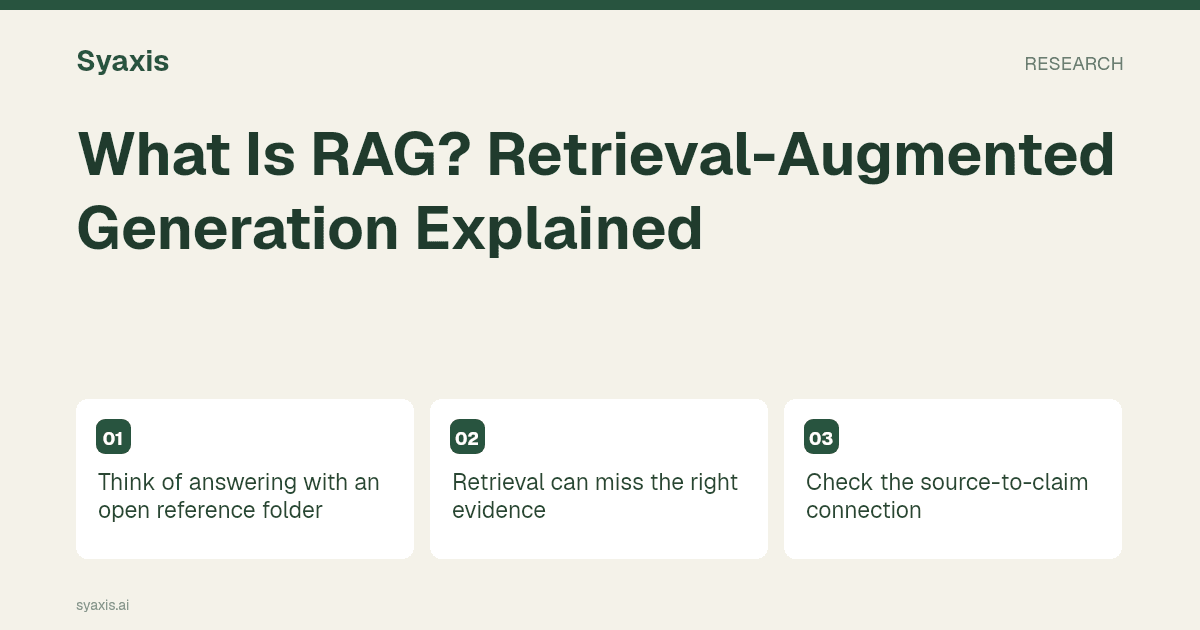
Think of answering with an open reference folder
For a question about a report, a system can retrieve relevant passages and pass them to the model. The generated answer then has source material to work from.
That is a useful way to understand the approach, not a promise that every uploaded file is retrieved or cited perfectly.
Retrieval can miss the right evidence
The relevant passage may not be selected, the document may be outdated or the source itself may be weak. A model can also misinterpret a retrieved passage.
A link beside an answer does not establish that the passage supports the exact claim.
Check the source-to-claim connection
Open the original source, locate the relevant passage and compare its scope with the answer. Check dates, definitions and whether the output turns a cautious finding into a certainty.
If two sources disagree, preserve the disagreement until you understand the reasons.
Use source-based answers in a deliverable
A research summary can become a presentation brief once its important claims are checked. Keep the source notes alongside the slides so later revisions remain traceable.
See checking presentation sources. This explanation does not imply that every product using retrieval has the same privacy, retention or training practices.
Follow a question from retrieval to the final claim
Retrieval-augmented generation combines a model’s generation with retrieved source material. The original RAG paper describes this combination of parametric and non-parametric knowledge. In a practical document workflow, the system searches for relevant passages and supplies selected material to the model before it answers.
Consider a fictional handbook with several travel policies from different years. A question about meal reimbursement requires the current policy and its applicable region. If retrieval finds an obsolete version, a faithful summary can still be wrong for the user. If it retrieves the correct passage but the answer omits an exception, the failure is in the interpretation. Inspect both the retrieved evidence and the final claim; the presence of retrieval is not an accuracy guarantee.
| Stage | Useful behavior | Possible failure |
|---|---|---|
| Find material | Retrieve the current relevant passage | An old or unrelated policy is selected |
| Provide context | Include the exception with the rule | The passage is cut before the limitation |
| Generate an answer | Explain what the source supports | The model adds an unsupported generalization |
| Verify | Open the cited passage | The link exists but does not support the claim |
الأسئلة الشائعة
Does RAG mean a provider trains a model on my document?
Retrieval and training are different processes. Retrieving a passage for a request does not itself mean model training occurs; actual provider data handling depends on the service and its terms.
Practice with questions for a PDF, then verify the resulting claims. The context window explainer describes another limit on the information available for an answer.
طلب أوضح. عرض تقديمي أقوى.
أحضر أفكارك إلى Syaxis وامنحها قصة وبنية وشرائح تستحق المشاركة.