A research-to-presentation workflow has two distinct jobs: establish what the evidence supports, then explain it to a particular audience. Combining those jobs too quickly can produce a persuasive deck whose claims are stronger than its sources.
The method below uses a bounded decision question, a source ledger and an audience-led outline. It applies whether research begins in a search assistant, a document collection or your own notes.
Research the audience’s decision rather than an unlimited topic.
Track the source behind each important claim.
Keep findings, interpretations and recommendations separate.
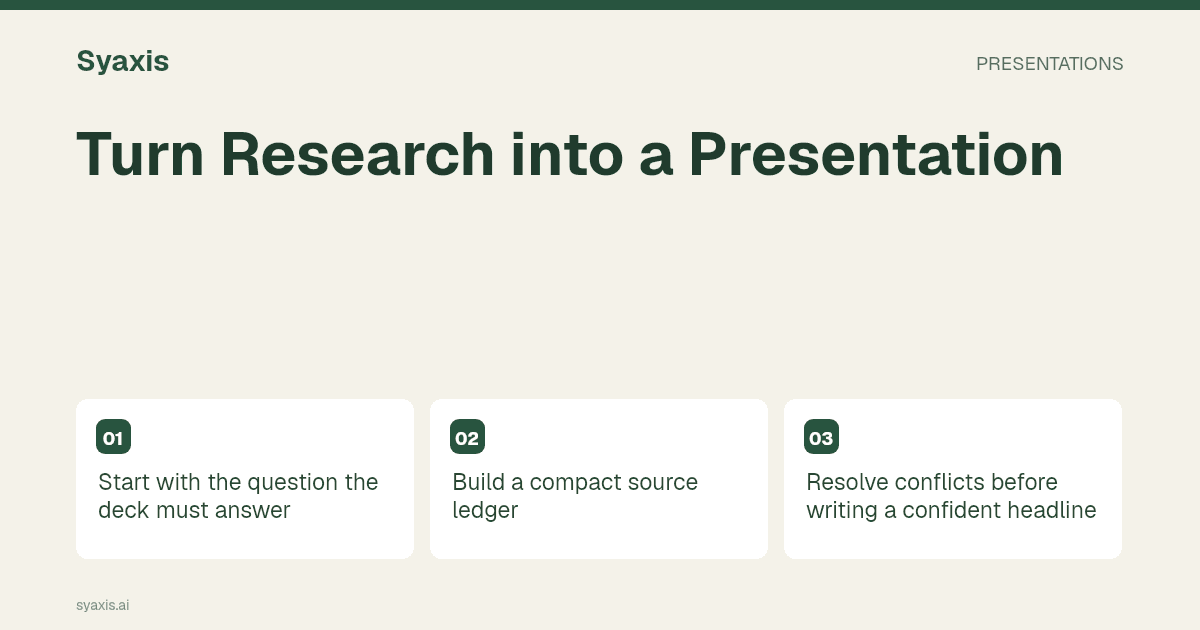
Start with the question the deck must answer
“Research onboarding” is open-ended. “What should we investigate before piloting a new onboarding checklist?” gives the work a boundary. List the audience, current decision, relevant period and information already available.
Identify the type of evidence needed. A product comparison may require current vendor documentation. A research finding may require the original study. A business recommendation may depend on internal records that public search cannot supply.
Build a compact source ledger
For each candidate claim, record the original source, date, relevant passage and limitation. This prevents a polished summary from becoming the only surviving evidence.
| Claim type | Source to seek | Boundary to preserve |
|---|---|---|
| Product feature | Current official documentation | Plan, surface and availability |
| Measured outcome | Original report or dataset | Period, population and method |
| Customer experience | Approved interview or feedback record | Who said it and what it can represent |
| Recommendation | Your reasoning from the evidence | Assumptions and alternatives |
Resolve conflicts before writing a confident headline
Two sources can disagree because they measure different things, cover different periods or use different definitions. Compare those conditions before deciding one source is wrong. If the disagreement remains unresolved, present it as an open question.
A synthesis should explain the relationship between sources, not merely stack summaries. For example, a survey might identify a reported difficulty while a usage log shows where the process slows down. Together they can motivate a pilot without proving the cause.
Translate the evidence into audience questions
Arrange the deck around what the audience needs to understand: question, context, strongest evidence, alternatives, recommendation and next step. Keep methodological detail where it changes the interpretation; move supporting detail only when the main slide remains accurate.
Use the research presentation example for a study readout or the consulting deck for an option recommendation. The two structures should not be treated as interchangeable.
Create and revise the presentation
Syaxis includes research in presentation creation and supports revisions through chat. Supply the approved source material and explain what is already verified. A separate Research surface is still forthcoming; this guide concerns the current presentation workflow.
Prompt: “Build a decision briefing from this source ledger. Preserve the distinction between observed findings and proposed responses. Include conflicting evidence that affects the recommendation. Keep a clear source reference for each important numerical claim and flag unresolved inputs.”
Review the final claim, not just the citation
Open the source behind each major headline. Check whether the headline has broadened the population, strengthened certainty or changed a comparison into a causal explanation. A citation beside an unsupported sentence does not make the sentence supported.
After export, inspect whether the important qualifications remain accessible in the file. For a detailed review process, see verifying AI presentation sources. If you need help choosing a research starting point, use AI research tools.
الأسئلة الشائعة
Should I generate the deck before checking the research?
A draft can expose missing questions, but do not treat it as ready to share until the important claims have been checked. Verification is easier when the source ledger survives the drafting process.
What if the sources do not support a recommendation?
Present the uncertainty and propose the next evidence-gathering step. A clear account of what remains unknown can be more useful than an unsupported recommendation.
Use the presentation outline guide to turn verified evidence into a coherent story.
طلب أوضح. عرض تقديمي أقوى.
أحضر أفكارك إلى Syaxis وامنحها قصة وبنية وشرائح تستحق المشاركة.